Miner Weekly: AI Wants Power Now. The Grid Wants Guarantees.
This article first appeared in Miner Weekly, a weekly newsletter by BlocksBridge Consulting, curating the latest news in energy, bitcoin, and AI compute from TheEnergyMag. Subscribe to receive it in your inbox once a week.
Before an AI data center can switch on its servers, the local utility may have to build a substation or reinforce the lines that feed it. That work can start years before the campus uses its first kilowatt-hour. If the developer scales back or walks away, the utility has already spent the money. Who pays then?
Five U.S. regional grid operators have now put proposals before federal regulators that address how data centers and other large electricity users connect to the grid. The filings respond to June orders from the Federal Energy Regulatory Commission (FERC), which asked six operators and their transmission owners to justify or revise their rules. The sixth, Southwest Power Pool, has a Nov. 20 deadline. Alongside faster connections, the proposals tackle a question that matters to anyone paying a power bill: How much of the cost should the customer that prompted the work be on the hook for?
The cost of a campus that never opens
A substation built exclusively for one campus is relatively easy to assign to that customer. A high-voltage line is harder. The campus may be the reason the utility needs to build it now, and the line may also improve reliability for the surrounding area. Once the utility decides how to share the cost, there’s a second question: Can it still collect the developer’s share if the project stalls?
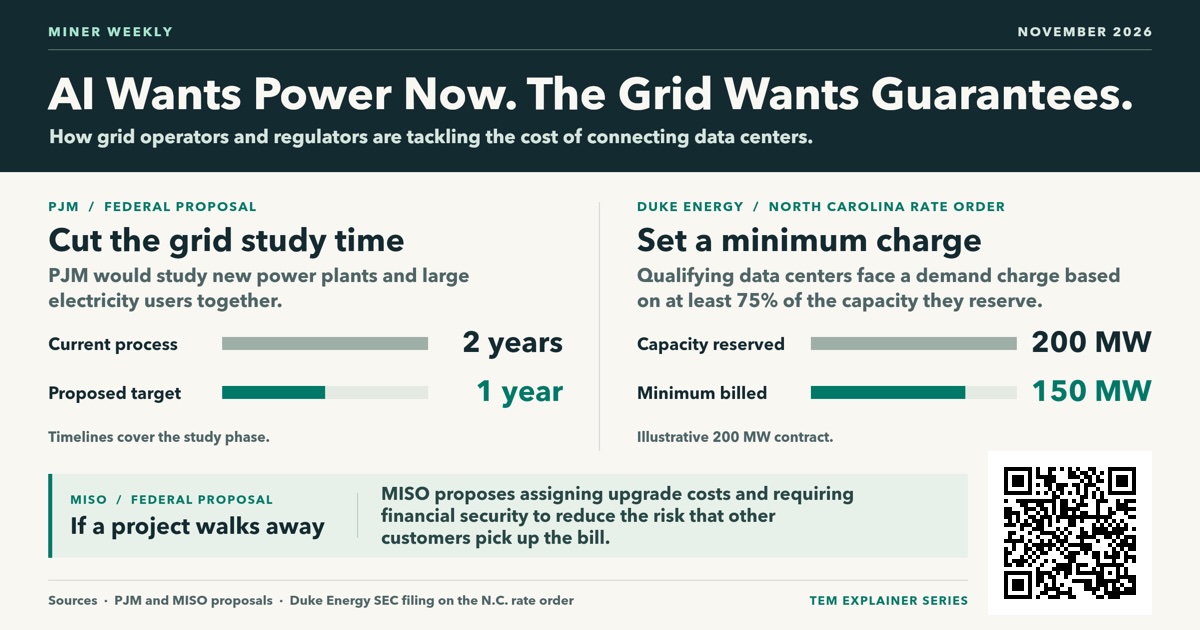
The Midcontinent Independent System Operator, or MISO, offers the clearest example of how the new protections could work. Its proposed agreements would spell out responsibility for upgrades, minimum payments, and the financial security a customer must provide. A public dashboard would show estimated upgrade costs and how they’re expected to be recovered. A minimum payment helps if a customer uses less power than it reserved. Financial security helps if the customer can’t make good on what it owes.
PJM has proposed studying large power users and new generators together, aiming to cut the study from two years to one. Its transmission owners filed a separate package covering rates, how upgrade costs would be shared and recovered, and financial protections. California ISO would leave the detailed cost-sharing rules to transmission owners’ tariffs. It also proposed a way for customers that can reduce their demand to connect before all grid upgrades are finished, subject to operating limits.
New England proposed its own cost recovery agreement and a public list of upgrades and their estimated costs. New York proposed firm and interruptible service, with a companion filing from its transmission owners. The details vary, and the new filings are proposals before FERC. A useful test for each is how much the customer commits before construction begins, and how much the utility can actually collect if the project changes.
Part 3 of TheEnergyMag Explainer Series looks at three ways a data center can change the cost of serving the grid: reusing existing infrastructure, paying for new equipment, and cutting demand when the grid is tight. Read Part 3 and the full series here.
FERC oversees the rates and rules for interstate transmission. For a state-regulated utility, the state commission decides how the utility’s share of those costs flows through to households, businesses, and other retail customers. North Carolina offered a timely example of that second layer this week, when state regulators established a separate rate schedule for certain Duke Energy (NYSE: DUK) data center customers.
Under the new schedule, a qualifying campus that reserves 200 megawatts would face a minimum demand charge based on 150 megawatts, even if it uses less. Duke’s filing also describes customer contributions for dedicated facilities, letters of credit for transmission upgrades, and damages for early termination. The method for deciding how much of a shared transmission upgrade to assign directly to the data center still has to be worked out.
If securing power means putting up more money before a campus opens, developers need to bring lenders and investors into the conversation earlier. We’re bringing those groups together with utilities, power producers, data center operators and miners at Energy Investors Forum 2027, June 15–16 at the Irving Convention Center in Dallas
Hardware and Infrastructure News
- Blackstone Trust to Buy Majority Stake in $5B Amazon Data Center Portfolio
- PJM Proposes One-Year Grid Studies for Data Centers and Power Plants
- Core Scientific Plans $1.3B Data Center Build Outside Dallas
- Giga Energy Signs $1 Billion Lease for Texas AI Data Center
- ChronoScale Signs Texas AI Deal With Contract Worth Up to $7.5 Billion
Corporate News
- Fortitude, Cypherpunk Account for 30% of Zcash Hashrate
- Luxor to Compensate Bitcoin Miners After Commander Breach Diverts Hashrate
- Keel Names Chief Legal Officer as AI Data Center Lease Talks Advance
- NVIDIA Forms National Security Committee Amid Tighter U.S. Export Controls
- Duke Energy Secures North Carolina Approval for Rate Base and Data Center Tariff
- NextEra Energy Rejects Rate Freeze Proposal in Dominion Acquisition
Financial News
- Cerebras Systems Reports $584 Million Nine-Month Revenue and Amends MBZUAI AI Compute Agreement
- HSBC Sold $300 Million Troubled Data Center Loan at Discount
Feature
- Inside the $900bn data centre bet behind Anthropic’s IPO – FT