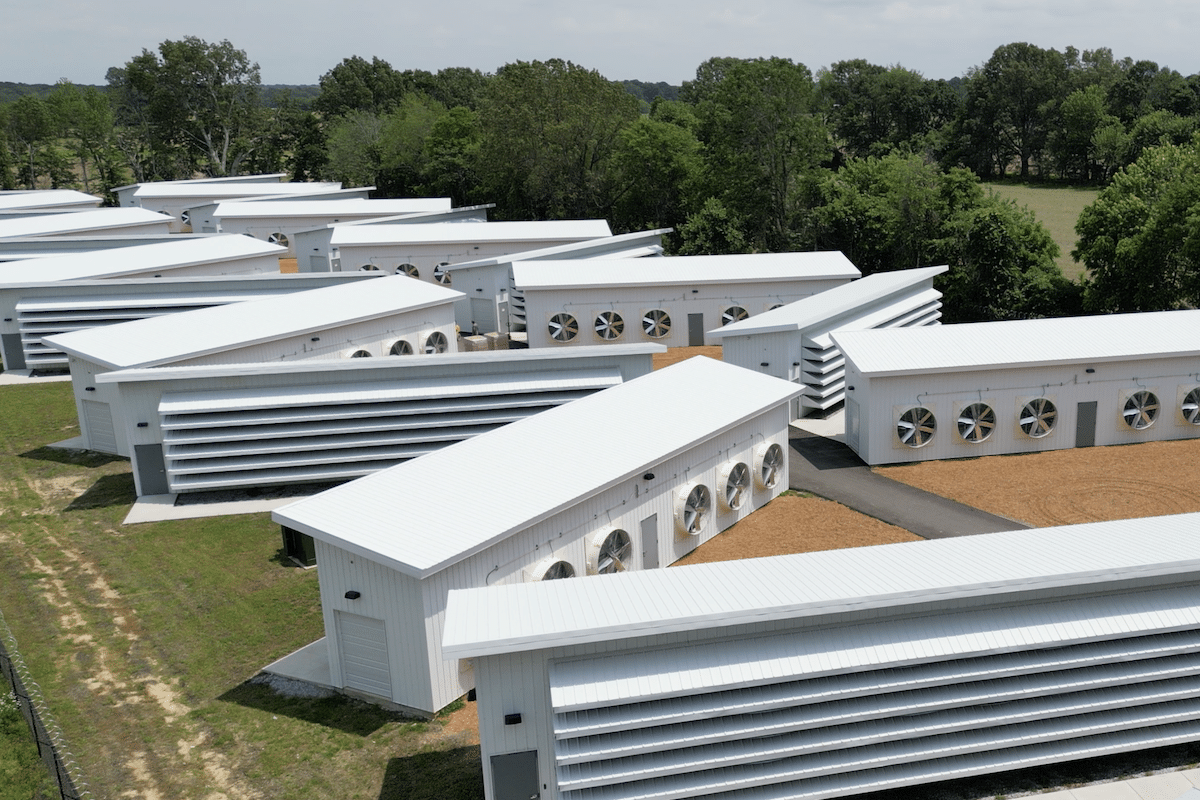
Soluna CEO Sees Stranded Wind Power as a Shortcut to AI Capacity

John Belizaire is betting that some of the fastest routes to powering AI data centers begin at wind and solar farms that cannot sell all the electricity they generate.
The chief executive officer of Soluna (NASDAQ: SLNH) Holdings said the company’s strategy is to place computing facilities next to renewable plants with existing grid connections, using power that would otherwise be curtailed while avoiding part of the yearslong process required for a new interconnection.

“It’s a source of energy that’s hiding in plain sight,” Belizaire said during a fireside chat at the Energy Investors Forum last week in Dallas.
For Soluna, the pitch is “speed to power,” an increasingly valuable attribute as AI developers compete for electricity in markets where generation and transmission expansion have failed to keep pace with proposed data-center demand.
Belizaire said modifying an existing connection at a generation site can take about one-fifth as long as seeking a new grid interconnection, though the timing will vary by project and still depends on engineering studies and regulatory approvals.
“We’re essentially bypassing these long queues by going to existing generation and using that as a pathway to grid access,” he said.
That claim goes to the center of Soluna’s planned transition. The Nasdaq-listed company currently earns most of its revenue from hosting bitcoin miners and from proprietary mining. It is trying to use the renewable-power relationships developed for that business to build larger facilities for AI and HPC.
Soluna reported no material revenue from that new segment in the first quarter. Its ability to finance, construct and lease the planned facilities remains the main test of whether its interconnection strategy can become a durable AI infrastructure business.
The most advanced effort is Project Kati 2 in Willacy County, Texas. At EIF, Belizaire said the company was designing a multiphase campus of as much as 350 megawatts, beginning with more than 100 megawatts of critical IT capacity. He said Soluna had entered exclusivity with a potential tenant and was negotiating a lease.
The project has since moved to a more formal development structure. A June regulatory filing showed that Soluna formed a joint venture with data center developer Metrobloks. The first phase calls for 100 megawatts of critical IT capacity, followed by another 250 megawatts. Soluna said in its first-quarter update that the initial phase had reached 30% schematic design and that procurement of long-lead equipment had begun.
Those steps do not amount to a completed lease or a fully financed campus. Large AI projects require billions of dollars of capital, specialized cooling and electrical systems, firm power arrangements and customers with the credit to support project financing. Delays in any one of those areas can undermine the speed advantage created by an existing interconnection.
Belizaire said Soluna’s prospective tenants range from neocloud operators, which may tolerate more flexible power arrangements for certain training workloads, to hyperscalers that typically demand extremely high availability. Serving the latter requires more than intermittent wind generation and grid access.
At Kati 2, Soluna is evaluating natural-gas generation as a second source of firm power and battery storage to buffer rapid changes in GPU electricity consumption, Belizaire said. The company is also designing the campus to accommodate sharply rising rack density and a potential transition toward 800-volt direct-current systems.
“The power density of these chips is staggeringly high,” he said, describing future-proofing as the principle guiding the facility’s design.
The combination illustrates a broader complication in claims about renewable-powered AI. Wind can supply inexpensive energy and an existing route to the grid, but a large data center seeking near-continuous uptime may still need grid electricity, batteries and thermal generation. The economics depend not only on the nominal megawatts attached to a site, but also on when that power is available and how reliably it can be delivered.
The pressure Soluna seeks to exploit is growing. ERCOT said more than 232 gigawatts of large loads were in its interconnection process in February—nearly three times the Texas grid’s record peak demand. Regulators have since approved a batch-review system for projects of at least 75 megawatts, allowing ERCOT to assess how much new demand can be supported in particular locations without compromising reliability.
Existing generation interconnections may give colocated projects an advantage, but they do not exempt developers from those reliability constraints. Grid operators must still study how a new load will affect transmission, voltage and the availability of power during periods when wind or solar output falls.
Belizaire’s longer-term argument is that electricity production and computing will cease to be treated as separate industries. As AI makes energy a larger component of the cost of producing digital services, he expects data centers to be designed around generation assets rather than simply connected to the grid after a site is chosen.
“You might even think of energy and compute as one integrated asset class in the future,” he said.