INTERVIEW SERIES: AI’s Infrastructure Race Runs Into a Slower Clock
Key Takeaways
- Developers must commit to power and cooling systems while AI hardware requirements continue to change.
- Mod42 advocates factory manufacturing and phased deployment to shorten schedules and adapt later installations.
- Faster construction still depends on electricity, equipment, permits and connectivity being ready.
AI data center developers face a risk that begins before their servers are switched on: the hardware requirements behind a facility’s design may change while it is being built.
Decisions about electrical distribution, cooling, floor loading and networking must be made ahead of equipment installation. For developers racing to deliver AI capacity, that creates a difficult balance between opening quickly and committing capital to infrastructure that can support successive generations of computing hardware.
“The biggest challenge I see customers facing is making long-term infrastructure decisions around technology that may change before their facility is even operational,” Valerie Crafton, chief revenue officer at Mod42, a manufacturer of modular data centers, told TheEnergyMag in a recent interview.
Crafton described customers making multimillion-dollar infrastructure decisions for hardware that might not arrive until the following year, while chipmakers continue advancing their product roadmaps.

Her proposed response is to combine standardized designs with hardware-specific engineering and deploy capacity in smaller increments. Later phases can then accommodate changing requirements rather than committing an entire development to assumptions made at the outset.
The approach addresses a broader mismatch between the pace of computing development and the time required to deliver physical infrastructure. It also leaves developers with an important question: how much flexibility can be built into a project without sacrificing the speed and standardization they are seeking?
Mod42 starts with baseline designs that can be adapted to a customer’s technology stack, Crafton said. Power density, cooling requirements and the physical characteristics of the equipment determine the changes required.
That places limits on the idea of a universally adaptable facility. Crafton said the company engineers around the hardware a customer plans to use, rather than assuming one design will accommodate every architecture.
“My philosophy is simple: Standardize what you can, customize what you must, and never allow yesterday’s infrastructure assumptions to dictate tomorrow’s computing capabilities,” she said.
Modularity also changes when developers commit capital. Instead of installing an entire large facility around projections of future demand and equipment requirements, they can build an initial phase and adapt subsequent deployments as hardware evolves, Crafton said.
The same approach can align construction with electricity that is actually available.
“The biggest gap is timing,” said Dipan Patel, chief operating officer of Duos Technologies Group, which develops and operates modular edge data centers. “AI customers plan in months, and utilities plan in years.”
Duos deploys standardized blocks sized to existing firm power and expands as additional utility capacity arrives, Patel told TheEnergyMag. He also emphasized the operating discipline required for a network of smaller facilities: consistent designs and procedures across locations.
Both companies have a commercial interest in modular development. Their responses did not include project-level comparisons establishing the total cost or delivery advantage over conventional construction.
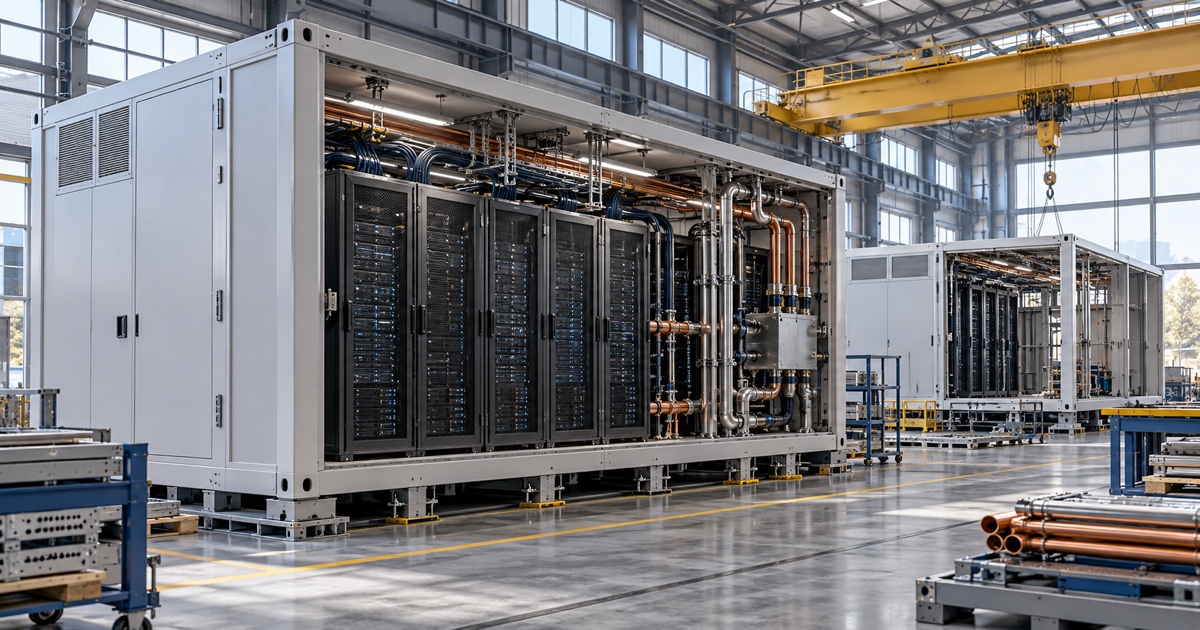
Crafton’s account nevertheless identifies a practical distinction in how projects can be organized. Mod42 manufactures integrated data center units off-site, allowing production to proceed alongside site development rather than waiting for construction activities to occur sequentially.
Once a design is finalized and production capacity is available, the company can deliver capacity in weeks, she said. But that manufacturing timetable does not cover the full process of obtaining electricity, preparing the location and bringing a facility into service.
“You can manufacture a data center in months, but if the transformers, generation equipment, or electrical infrastructure aren’t ready, you still cannot energize it,” Crafton said.
The International Energy Agency estimated in its 2025 Energy and AI report that grid constraints could delay around 20% of global data center capacity planned for construction by 2030. Its analysis identified locating developments in areas with available electricity and grid capacity as one way to reduce that risk.
Those constraints are influencing location as well as project size.
Crafton described developers evaluating secondary markets, existing industrial properties and regions with alternative energy resources. Smaller deployments can make use of sites that would not accommodate a much larger campus, while later expansion can follow the availability of power and customer demand.
But moving toward available electricity can introduce other delays. Patel said some powered sites are distant from long-haul fiber routes, and establishing diverse connections can add expense and months to a development.
On-site generation offers another potential route to earlier operations, with its own conditions. Patel said natural gas generation is realistic where pipeline capacity and air permits align. Crafton identified fuel supply, emissions, operating costs and reliability as considerations.
Battery storage can support resilience and bridge some interruptions, she said, but cannot replace a continuous energy source.
The hardware challenge also remains after a site is selected. A shorter delivery schedule may reduce the interval between design decisions and equipment installation, but future phases still need to account for changing power densities, cooling arrangements and physical requirements.
For Crafton, that makes coordination across the project as important as manufacturing speed.
"Manufacturing speed alone isn’t the answer,” she said. “The entire project needs to be planned around that accelerated delivery model from day one.”