For AI and Bitcoin Investors: The Grid’s ‘Secret Sauce’ Just Got Even Sweeter

A Duke Study with BTC Mining Hybrids Unlock 76–126 GW of Headroom with ZERO AI Downtime
Editor’s note: This article was contributed independently by Earnest Hamilton, AKA Financial Ernie. Earnest works in the power generation sector and has a keen interest in the energy ecosystem, branching into both bitcoin mining and the HPC sector for his investment thesis around short-term energy supply and demand. The views and opinions expressed are solely those of him and do not reflect those of TheEnergyMag.
As an investor, you may be long NVIDIA, Microsoft, and maybe some hyperscaler exposure. You’ve seen the power panic headlines. But what if someone told you the exact same megawatts that are about to power the AI boom can also mine Bitcoin on the side, and the combo lets you plug tens of GW straight into the existing grid today with almost no new buildout?
It’s not a fairytale, it’s the Duke Nicholas Institute study (Feb 2025) layered with a real-world hybrid revolution already happening at publicly traded Bitcoin miners. This may be the smartest, most investable flex play for the 2027–2030 AI supercycle.

Quick Duke Refresher
The Duke study examines how the U.S. electricity grid can handle rapidly growing demand, especially from data centers and AI, without immediately building massive amounts of new generation and transmission infrastructure. It focuses on flexible loads where large electricity users can temporarily reduce or shift their consumption during short periods of grid stress through workload scheduling, on-site power, or operational changes. By modeling the concept of “curtailment-enabled headroom,” the study concludes that nearly 100 GW of such new flexible loads could be integrated across the 22 largest U.S. balancing authorities (covering ~95% of the grid) with only minimal, infrequent curtailments. This supports faster economic growth while keeping the grid reliable and affordable.
The U.S. grid has 76 GW of “curtailment-enabled headroom” at just 0.25% annual curtailment (~22 hours/year), scaling to 98 GW at 0.5% and 126 GW at 1%. Most events are short (~2 hours avg) and mostly have partial load impacts. Today, data centers must flex via workload shifting or on-site generation. Here’s the paradigm shift: data centers can pair always-on AI databases with Bitcoin mining that can shut off 100% instantly. The steady load stays rock-solid. The flexible layer eats every curtailment signal. This maximizes power headroom without touching AI SLAs (that five-9 uptime requirement).

What the “Blend of Compute” Actually Looks Like
Picture a single 200 MW site:
- 60–80% Steady AI Layer: GPUs and TPUs humming 24/7/365 for training, inference, or cloud workloads. This is the high-margin, hyperscaler-leased part (Microsoft, Google/Fluidstack, or AWS) contracts paying premium rates with zero tolerance for downtime.
- 20–40% Flexible BTC Layer: ASIC miners that run flat out when power is cheap/abundant and instantly power down to zero the moment the grid (or utility) signals curtailment. No partial throttling, they flip off like a light switch.

Rethinking Load Growth (Nicholas Institute for Energy, Environment, and Sustainability)
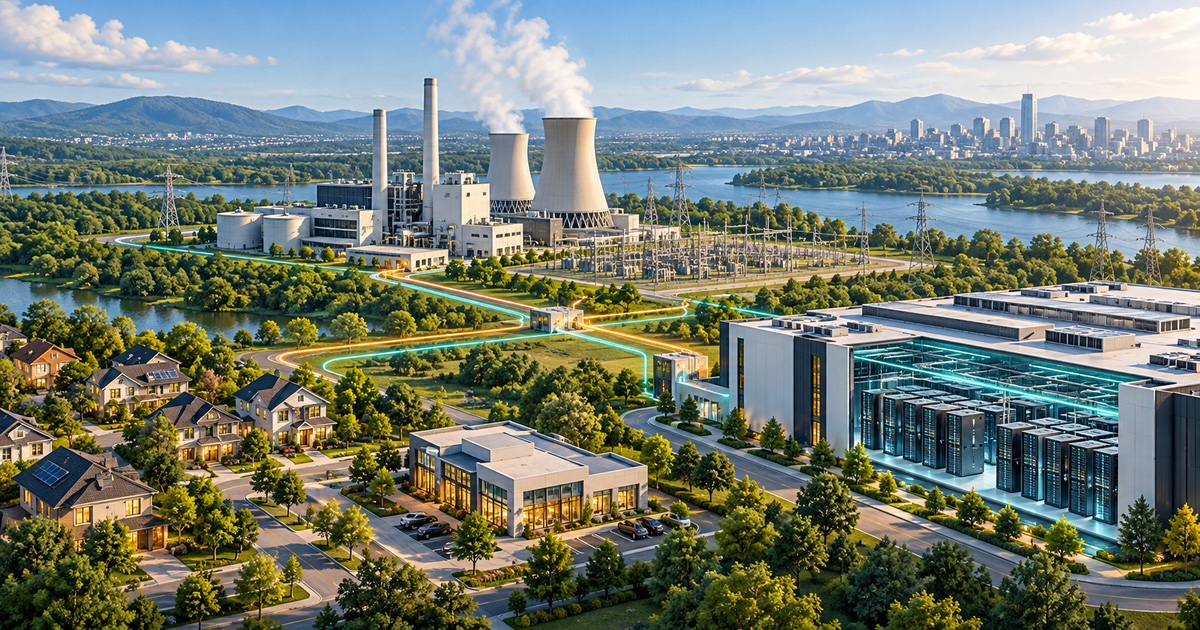
This shared infrastructure magic uses the same power interconnect, cooling systems, land, and substation. Some of the CapEx is already sunk since the sites were constructed for miners years ago. High voltage lines and substations are ready to pivot to primarily supporting HPC.
When curtailment hits, BTC miners go dark, the AI portion never blinks, and the entire site counts as “flexible load” under Duke’s math. Grid still gets relief, and everyone wins.
Real operators are already planning exactly this:
- CleanSpark (NASDAQ: CLSK) openly calls it the “interruptible load” edge. Utility companies are more likely to contract power to them because they can blend mining with AI and still offer grid services.
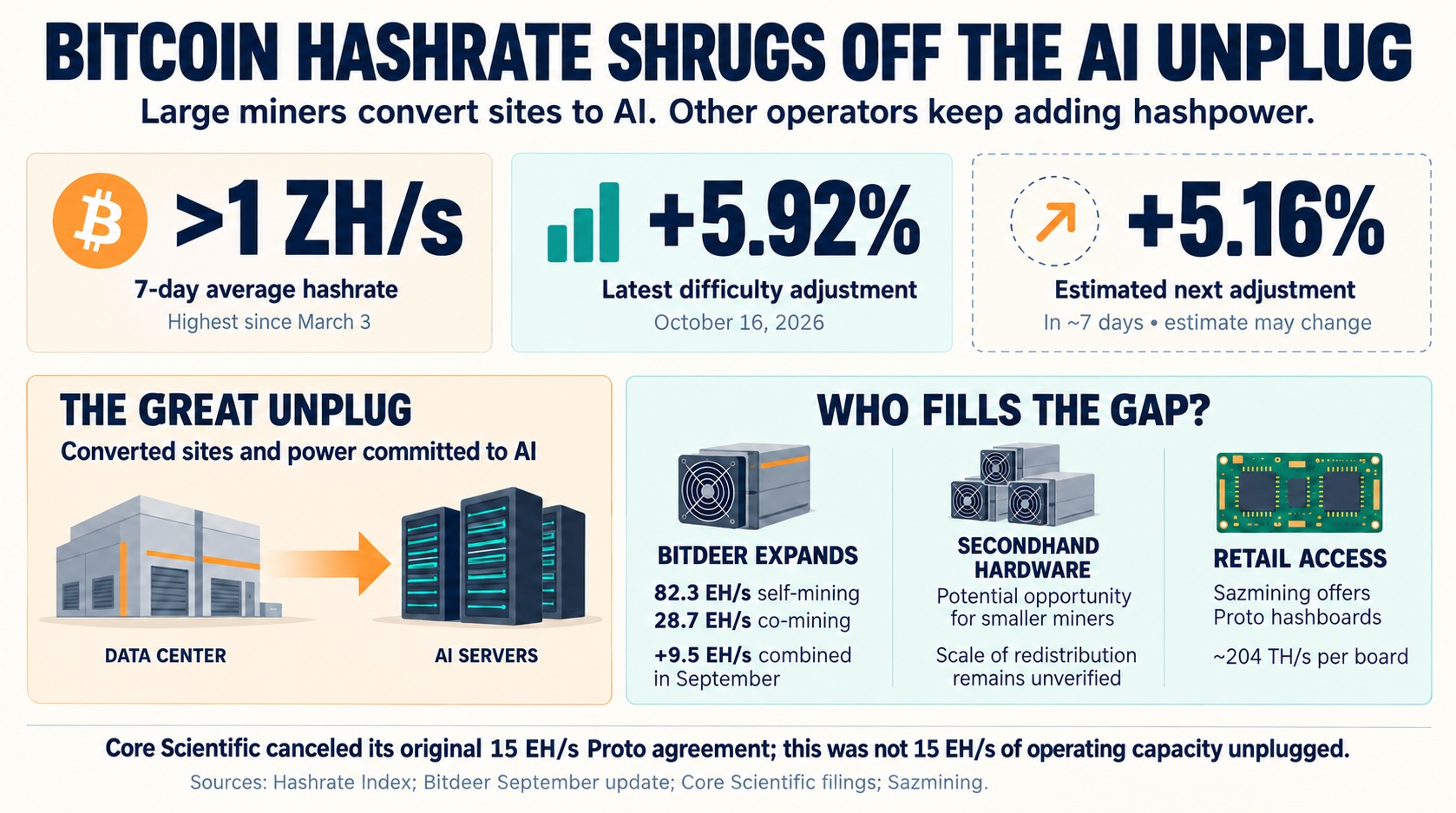
- IREN (NASDAQ: IREN), Core Scientific (NASDAQ: CORZ), Riot Platforms (NASDAQ: RIOT), Cipher Mining, TeraWulf (NASDAQ: WULF), Hut 8 (NASDAQ: HUT) have all signed AI/HPC leases and many still have Bitcoin mining capacity live on the same campuses.
- Total major leases/agreements signed: ~8–12 (varies on how phased/amended deals are counted; many are multi-phase or include options).
- Total MW under contract: ~2,050–2,300 MW critical IT load (plus significant expansion options).
- Contracted revenue potential exceeds tens of billions over 10–15+ years.
- Some sites are hybrid today, and others are converting racks on the fly as leases are signed.
- ERCOT examples where curtailment is an actual revenue source on its own: Riot once earned more from demand-response payments (shutting down >95%) in one month than from actual Bitcoin mining. That’s real revenue stacking on top of AI leases.
Reviewing 2027–2030 Projections: This Hybrid Supercharges the Headroom
AI/data center demand is still exploding (U.S. could add 60–90+ GW new load by 2030 per S&P 451, Grid Strategies, Berkeley, etc.). Bitcoin mining capacity (currently ~10 GW continuous in the U.S., with plenty of idle/convertible rigs) is the perfect flexible partner.

The blend means:
- You can stuff more total GW into Duke’s 76–126 GW window because the curtailable portion is perfectly flexible (BTC switch 100% off in seconds).
- AI gets online years faster (no waiting for new transmission).
- Flex power for BTC mining becomes stable, high-margin AI revenue (valuation with 20–30x market multiples vs. pure mining’s 3–5x) while still monetizing excess power or demand response credits.
- Grid operators love it since the flexible load actually helps stability instead of stressing it. Texas already mandates flexibility for big new loads, and more states will likely follow.
Public miners with secured power, existing sites, and current/planned AI contracts (CLSK, IREN, CORZ, RIOT, WULF, etc.) are sitting on the ultimate arbitrage: cheap power with flex capability and dual revenue streams. Many are already trading at premiums as the market wakes up to this.
Why This Is Pure Alpha for Your Portfolio
- AI exposure without the grid nightmare: Hyperscalers get capacity now. Your semis and cloud stocks accelerate.
- BTC upside as a bonus: Mining still prints when power prices are low and now it’s the “curtailment insurance policy.”
- Defensive moat: These hybrids lower overall system costs, reduce blackout risk, and make utilities happier (leading to friendlier regulation and tariffs).
- Thematic two-fer trade: Long the digital economy and the energy transition.
Wall Street is still obsessing over chip shortages and raw capex. The real edge is power with flexibility. The Duke study handed us the excess load heat map. Bitcoin miners are already building hybrid vehicles to drive on it. Many are starting to label this movement Mullet Mining where AI GPUs are the core business (in the front) and bitcoin mining bridging the PUE gaps (in the back) and ready to curtail immediately when the grid needs it.
Watchlist adders:
Public BTC/AI hybrids with big power pipelines and announced hyperscaler deals. Earnings calls are starting to brag about “blended compute” and curtailment revenue, so listen for it.
What’s your take – is this the smartest way to scale AI and keep Bitcoin mining viable? This isn’t theory anymore. It’s already online.
Always DYOR as power markets move fast.