Who Owns the Stack: From Bitcoin to AI, the Race for Power Is Going Off-Grid

In the first installment of this series, we explored a foundational idea: Bitcoin mining was never just about digital currency. It was designed as a long-term energy system running on a supply schedule that extends over more than a century.
In the second installment, we examined how that system is not unique to Bitcoin. Modern AI data centers are built on the same physical foundation—chips, power, cooling, and infrastructure—all working together to turn electricity into Bitcoin mining and AI processing at scale.
The AI boom has increased demand exponentially, requiring cutting-edge infrastructure and high-efficiency technology to support grid resilience, ultimately reshaping how the digital future is built.
Across the technology sector, developers are increasingly moving beyond traditional grid reliance, securing electricity more directly through dedicated energy assets. This “bring your own power” approach may feel new to AI, but it is a playbook Bitcoin miners have been refining for years.

This kind of vertical integration has become a defining feature of the Bitcoin mining industry. As companies have undertaken expansion into new markets, including the United States, they have worked to identify existing infrastructure. However, this wave of expansion has not stopped at data centers—it extends into power itself, as operators seek to improve reliability, sustainability, and affordability of the energy supply through direct ownership and partnerships with energy companies.
This third installment builds on that evolution. If Bitcoin mining and AI data centers share the same underlying system, the next question is how companies position themselves within it. What emerges is a spectrum of business models—ranging from outsourcing to full vertical integration.
The more of this stack a company controls, the more capital-intensive it is and the more it influences its costs, performance, and ultimately, its returns.
But it is important to note that this stack is not static—and neither are the companies operating within it.
As Bitcoin mining and AI data centers scale on the same underlying infrastructure, the line between their business models is beginning to blur. The two seemingly distinct industries are increasingly becoming one shared system, with stakeholders moving across it in real time.

The Entry Point: Asset-Light Deployment
At the most basic level, participation in both Bitcoin mining and AI computing begins with deploying hardware.
In Bitcoin mining, this means owning ASIC machines—specialized chips designed to perform a single task—and placing them into facilities operated by others to generate Bitcoin. In AI computing, the equivalent is deploying GPUs into data centers, where they are used to train models and run workloads for customers.
In both cases, companies own the machines—but not the infrastructure.
That infrastructure is provided by colocation operators, which supply power, cooling, and physical space to run compute at scale. Historically, this has been viewed as a supporting function. Increasingly, it is becoming one of the most important parts of the business.
Colocation is no longer just about hosting machines—it is about monetizing power and infrastructure.
Across Bitcoin mining, this model has long been embedded in the industry. Companies like ABTC have deployed miners hosted through parent infrastructure operators such as Hut 8 (NASDAQ: HUT), while others, such as Cango (NYSE: CANG), operate fleets hosted in facilities managed by Bitmain. In each case, the separation between hardware ownership and infrastructure operation defines the business model.
That same structure is now emerging in AI.
Companies like Fluidstack are deploying GPU clusters through partnerships with infrastructure providers including Cipher and TeraWulf (NASDAQ: WULF), leveraging existing power-connected sites to serve AI workloads without owning the underlying facilities. Bitdeer (NASDAQ: BTDR) is actively developing AI colocation capacity at scale, including a planned 180 MW facility in Tydal, Norway that is currently in negotiations with a potential tenant.
As AI demand accelerates and power becomes the limiting factor, infrastructure with existing grid access is becoming increasingly valuable. Many sites originally built for Bitcoin mining are now well-positioned to support AI workloads, and over time, a growing share of these facilities—particularly across the U.S. and Europe—are expected to transition toward AI and high-performance computing applications.
In that sense, colocation is no longer just the entry point to the stack.
It is becoming a bridge between two industries—connecting energy, infrastructure, and compute demand in a single, evolving system.
Controlling Infrastructure
As companies move up the stack, the next step is owning the physical environment itself.
At this stage, companies are no longer just deploying hardware. Instead of relying on third-party hosting, operators build or acquire their own facilities, including data centers, substations, and cooling systems.
This shift changes operations significantly. Infrastructure ownership allows operators to control power costs, optimize performance, and reduce dependency on external providers.
But increasingly, the value of infrastructure is not just in the buildings—it is in the power connections attached to them.
That dynamic is now playing out across industrial assets that were once considered obsolete, allowing for companies to turn underutilized facilities into powerful engines for growth
Companies like Alcoa have begun exploring the sale of idled aluminum smelter sites to digital asset firms such as NYDIG, while Century Aluminum has sold a Kentucky facility to TeraWulf, which is now pivoting toward AI and high-performance computing.
Many of these sites faced shutdown due to the gradual offshoring of high-paying industry jobs to other countries. But they share one critical feature: they are already connected to the energy grid at scale.
That interconnection—often the hardest and slowest part of building new infrastructure—has suddenly become a valuable asset in its own right.
As a result, facilities originally built for heavy industry are finding a second life as compute infrastructure, repurposed to support Bitcoin mining and AI workloads alike. This is bringing critical technical roles back to the United States, rebuilding key infrastructure, and accelerating the country as a global leader in technology and innovation.
In this environment, owning infrastructure is no longer just about controlling operations. It is about securing access to energy systems that can handle increasing demand while supporting overall resilience.
Bring Your Own Power
But even that pool of grid-connected infrastructure is limited.
The number of industrial sites with existing high-capacity interconnections is finite, and much of it has already been identified or repurposed by major industries. As consumer demand for computing accelerates—particularly from AI—the scale of power required necessitates solutions to maintain grid resilience while deploying new technological solutions.
In other words, the constraint is no longer just where infrastructure exists. It is whether the energy grid itself can keep up. That pressure is now forcing a broader shift.
Across major power markets, operators are confronting a new reality: connecting large loads to the grid is becoming more complex and increasingly uncertain. Consequently, regulators are beginning to revisit how large energy users are integrated into the system.
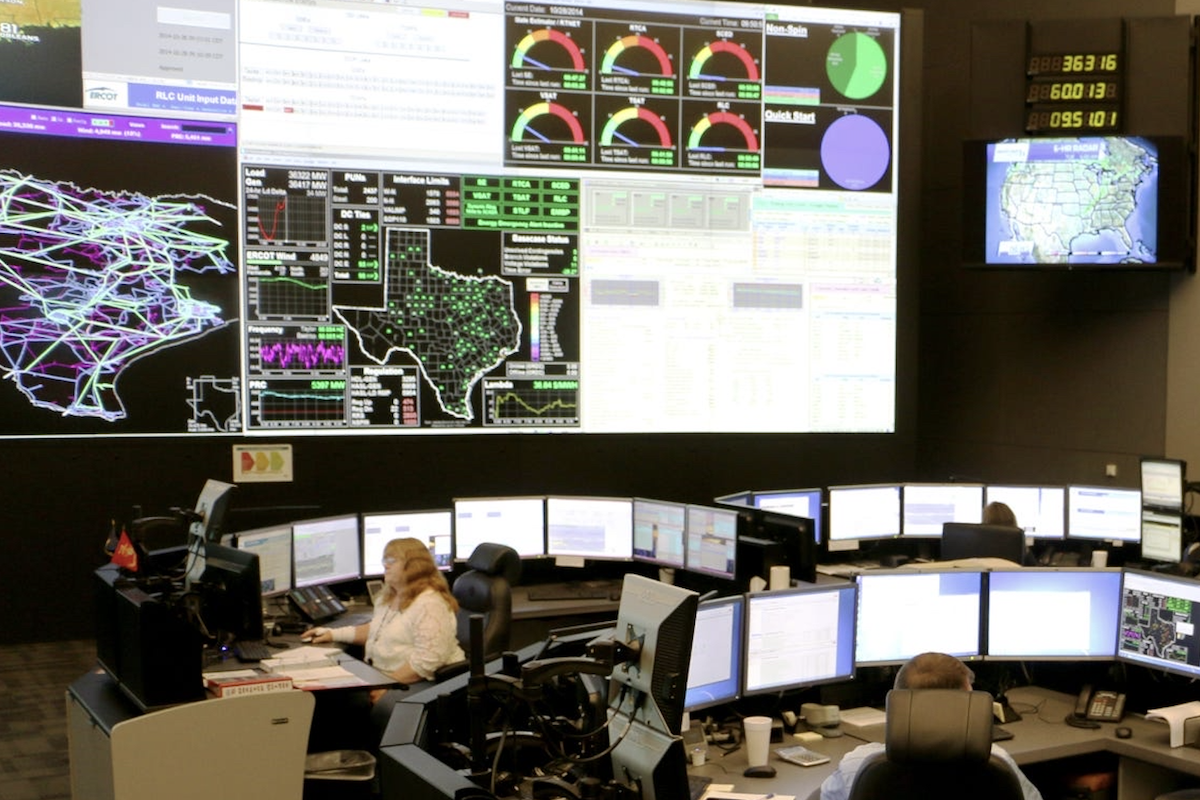
In regions like PJM and ERCOT, grid operators have already started to adjust their frameworks in response to surging demand from data centers and other high-load users. New rules and proposals are emerging to govern how large-load data centers connect to the grid, how costs are allocated, and how reliability is maintained amid rapidly growing demand.
To address these challenges, a growing number of operators are moving beyond the grid altogether.
A clear example of this approach can be seen in the partnership between Amazon and Talen Energy, where data center infrastructure is being developed alongside nuclear generation capacity. While AWS does not own the power asset outright, the structure effectively aligns compute with a dedicated energy supply—mirroring the same principle that has long underpinned Bitcoin mining operations.
In Bitcoin mining, this has long included co-locating with underutilized energy sources. Companies like New West Data flare gas from oil production sites and use that power to energize Bitcoin miners for extra cash flow. In 2020, Greenidge Generation became what was known as the first power plant to directly participate in bitcoin mining, reviving an asset that would have been shut down due to its lack of competitiveness in the power market.
In AI computing, a similar model is emerging. Data center developers are increasingly partnering with—or directly building alongside—power generation assets, including natural gas, nuclear, and most importantly, renewable energy.
This “bring your own power” model transforms electricity from a cost center into a strategic advantage. It allows operators to stabilize pricing, ensure availability, and align compute capacity with energy supply.
In Bitcoin mining, this evolution has been unfolding for years and is only growing.
A clear example is Bitfarms. The company historically operated as a self-mining business, owning infrastructure and deploying its own computational power. But with the acquisition of Stronghold, Bitfarms moved upstream into power generation, gaining direct control over energy assets. It later rebranded to Keel Infrastructure, signaling a broader transition away from pure Bitcoin mining toward a model that can support AI and high-performance computing workloads.
In effect, Bitcoin companies are building the expertise to power the demand base for the technologies of the future, including AI.
Full Vertical Integration
For some operators, even taking ownership of power is not the final step.
At the highest end of the spectrum, companies can control nearly every component of the compute system: power generation, infrastructure, hardware deployment, and even chip design.
In AI computing, hyperscalers (like Amazon Web Services, Microsoft and Google) are beginning to move in the same direction—developing custom chips, securing long-term energy supply, and building large-scale data center campuses tailored to their workloads. In Bitcoin mining, this model is no longer theoretical. It is already taking shape.
Canaan (NASDAQ: CAN), the earliest Bitcoin ASIC designers with its Avalon brand, has expanded beyond hardware into operating its own mining infrastructure. In recent years, it has scaled proprietary computing power by deploying its own machines across sites it controls directly or through joint ventures. Earlier this year, Canaan deepened that strategy by acquiring Cipher Digital (NASDAQ: CIFR)’s 49% stake in the Texas joint ventures with WindHQ, a wind electric power generator, moving its exposure further upstream in the stack.
A similar trajectory can be seen with Bitdeer. Originally focused on cloud mining and proprietary operations, the company has steadily expanded its control over infrastructure, scaling its exclusive computing power to around 70 EH/s. It has also moved into power generation, including the acquisition of land and a license for a 101 MW permitted plant in Canada, further integrating energy into its operating model.
At the same time, Bitdeer is extending horizontally into AI processing. The company has begun deploying its own GPU infrastructure for AI cloud services while exploring high-performance computing colocation opportunities with tenants.
This dual expansion—up the stack into power and across into AI workloads—illustrates how the boundaries between Bitcoin mining and data center infrastructure are beginning to dissolve. At this level, the objective is no longer just efficiency. It is access.
By operationalizing each layer of the stack, operators can optimize performance end-to-end, reduce exposure to external constraints, and define their own capacity limits.
While few companies fully occupy this position today, the direction of travel is clear. The closer operators move toward full integration, the more they transform from users of key energy and digital infrastructure into builders of it.
Same Stack, Different Positions
What emerges from this comparison is not a story of two separate industries, but of one shared system with multiple points of participation.
Bitcoin mining and AI data centers differ in their workloads and customers. But structurally, they operate along the same continuum of ownership—from asset-light deployment to infrastructure ownership, to securing power directly, and ultimately to full vertical integration.
More importantly, those positions are not fixed. Companies are constantly repositioning themselves—moving up the stack to gain control, or across it to capture new sources of consumer demand. These dynamics have strengthened the Bitcoin-AI coexistence approach: secure a sizable power contract and immediately monetize it with proprietary bitcoin mining power while seamlessly retrofitting the infrastructure for higher-margin AI computing colocation.
Bitcoin miners, by necessity, began solving these problems early, and AI companies are now arriving at the same conclusions. The key difference is no longer the system itself, but how each company chooses to navigate.
In the next installment, we will take this one step further: How these models are beginning to converge—and what that means for the future of energy, compute, and capital.