TEM Explainer Series: Large Power Users Can Mean Smaller Energy Bills

Where power plants have room to serve them, data centers can help share the costs that other customers already pay.
Homeowners pay for insurance even when they never make a claim. Electricity customers pay for a similar safeguard. Part of their bill helps keep power plants ready for the busiest hours and unexpected emergencies.
Those plants cost money even when they are not producing much electricity. A new customer can help cover that bill, provided there is enough power to serve it without weakening the system’s safety margin.
The first piece of this four-part data center explainer series looked at what goes into an electricity bill. Now the second part focuses on the cost of making electricity and how data centers can affect what other customers pay.

Fuel Alone Doesn’t Tell the Full Story
Fuel has undoubtedly become more expensive. A 2026 study by Lawrence Berkeley National Laboratory and The Brattle Group found that natural gas prices paid by U.S. power generators rose 36% in 2025. Additionally, fuel and wholesale power costs contributed to higher retail electricity prices in 21 states.
With data centers expanding at the same time, it is understandable to connect their electricity appetite with rising bills. But fuel prices respond to broader supply and demand conditions; they can rise or fall even without new data centers. The arrival of large customers and higher electricity prices does not, by itself, tell us how much one caused the other.
Another cost often gets overlooked: customers also pay to keep power plants available for the busiest hours and emergencies. That cost is separate from the fuel burned to produce electricity.
But building and maintaining those plants takes investment. Companies need confidence that customers will buy enough power to help cover the cost. Expected demand therefore shapes both how much generating capacity is needed and whether investing in it makes financial sense.
PJM’s capacity auctions show this relationship.
Paying for Capital Investment in Power Plants
PJM stands for Pennsylvania-New Jersey-Maryland Interconnection. It manages the regional grid across all or parts of 13 states and the District of Columbia, serving more than 67 million people. It also runs auctions that pay power plants and other resources to be available when needed. These are called capacity auctions.
In July 2024, the auction price for much of PJM’s region jumped about 833%. It rose from $28.92 to $269.92 per megawatt of capacity per day for June 2025 through May 2026. This was a rise in the price of keeping resources available, not an 833% increase in household bills.
PJM pointed to several causes. Power plants had retired, expected demand had grown, and the rules for judging reliability had changed.
Higher prices can encourage companies to build. But PJM has warned that price signals alone may not be enough. Developers also need financing, permits, equipment and confidence that customers will buy the power. New plants take time to arrive, while customers can face higher costs sooner.
New Customers Can Help Share Existing Plant Costs
Where power is already in short supply, adding a large customer can push up the price of electricity and increase the need for new plants. That is the concern illustrated by PJM.
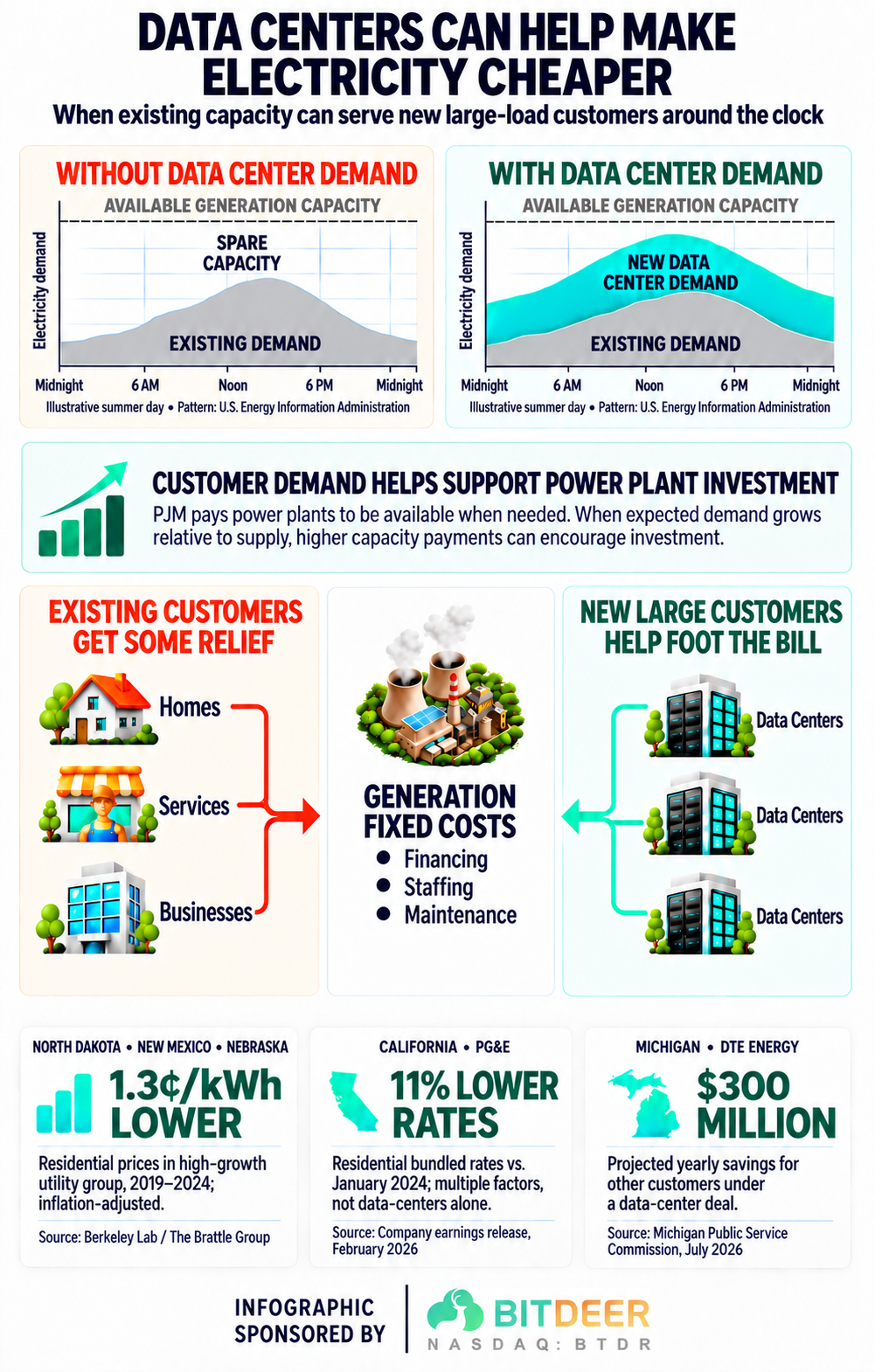
Elsewhere, existing plants may have room to serve more customers. Data centers usually need power around the clock. If that power is available throughout their operating hours, they can become dependable buyers. Required emergency reserves still need to be protected.
Think of a plant’s loan payments, staffing and upkeep. These bills do not disappear during quiet hours. Selling more electricity can spread those fixed costs across more sales. The new customer must pay enough to cover the extra cost of serving it and contribute to the costs already being shared. Contracts and rate decisions determine how any savings reach other customers.
Michigan offers an example. In July 2026, the Michigan Public Service Commission cited projected savings of $300 million a year for DTE Energy’s other customers under its first data-center special contract. The new customer’s payments would help cover shared system costs. This is a forecast under the broader deal, not a saving from generation alone.
Some facilities may also be able to ease pressure on the grid during its busiest hours. That does not have to mean switching off critical services. A July 2024 report from the Secretary of Energy Advisory Board identified possible options, including on-site power and moving computing work to another time or location.
PJM calls for agreed reductions in electricity use through demand response. It says these reductions can help avoid expensive plants needed mainly during peak periods and support reliability. But the reductions must be dependable. A data center’s ability to participate depends on its equipment, workloads, and customer commitments. Around-the-clock facilities cannot simply be assumed to switch off when asked.
Lower Bills Depend on Local Supply and Who Pays
PJM shows why higher prices do not always bring new power quickly enough. Michigan shows how a large customer’s payments can help cover costs others would otherwise carry. Neither outcome applies everywhere.
Data centers can help where existing plants have room to serve them and their payments reduce the burden on other customers. Some may also be able to ease demand at critical times. These benefits are possible, not automatic, and they do not remove the need for new plants where supply is tight.
In the next piece, we turn to the wires and substations that carry electricity to customers, and how growing demand affects the cost of delivering it.