
Nvidia, Wall Street Firms Target $500 Billion for AI Infrastructure
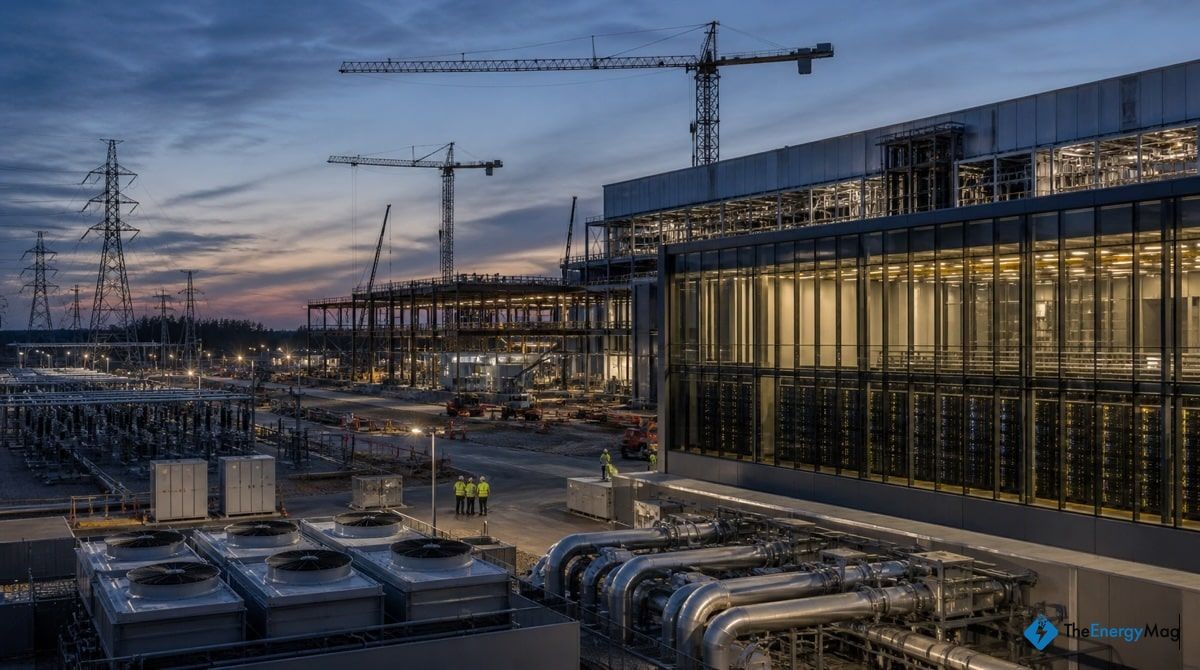
AI-generated image: synthetic visual, not an actual depiction of events, people, or locations.
Nvidia is partnering with six of the world’s largest investment firms to create financing platforms intended to mobilize more than $500 billion for AI infrastructure, seeking to ease a capital bottleneck that could constrain demand for its chips.
Apollo Global Management, BlackRock, Blackstone, Brookfield Asset Management, Goldman Sachs and KKR will establish independently managed platforms offering financing to qualifying AI laboratories, enterprises and cloud-computing providers, Nvidia said in an announcement Monday.
The headline figure represents aggregate third-party capital that the platforms are designed to raise over time. It is not Nvidia revenue, a single fund or a commitment to one customer. Nvidia did not identify individual projects or say how the total would be allocated among the financial firms.
The arrangement would give AI companies access to institutional capital for the costly combination of processors, networking equipment, data centers, cooling systems and electricity required to train and operate increasingly large models. For Nvidia, broader access to financing could help customers move ahead with projects that might otherwise be delayed by their balance sheets or borrowing costs.

Nvidia has identified capital availability as a direct risk to its growth. In its latest quarterly filing, the company said shortages of data centers, energy or financing could hurt its revenue and financial performance. Less-capitalized customers may struggle to fund large projects, delaying deployments or reducing their scale, Nvidia said in the filing.
The initiative marks a further convergence between technology suppliers and the private-capital industry. Asset managers have been treating data centers and computing equipment more like conventional infrastructure, using long-term contracts and expected customer payments to support debt and equity investments.
BlackRock, Microsoft, Nvidia and other investors previously agreed to acquire Aligned Data Centers in a transaction valued at about $40 billion. The business had about five gigawatts of operational and planned capacity, illustrating the scale at which financial institutions are already entering the sector. The acquisition was announced in October 2025 and was expected to close in the first half of 2026, subject to regulatory approval, according to the Associated Press.
The latest platforms could expand that model across a larger pool of projects and customers. Nvidia Chief Executive Officer Jensen Huang said the partnerships were meant to help customers obtain scarce computing capacity at scale, while the participating firms emphasized their ability to provide long-duration capital.
The plan also underscores the extraordinary funding requirements of the AI expansion. Nvidia reported $75.2 billion of data-center revenue for the quarter ended April 26, up 92% from a year earlier. Total revenue reached $81.6 billion, and the company forecast $91 billion for the following quarter, according to its latest earnings release.
At the same time, the partnerships may intensify scrutiny of the financial links connecting chip suppliers, cloud operators, model developers and their investors. Nvidia invested $18.6 billion in private companies and infrastructure funds during its latest quarter. Some of those businesses may indirectly buy or use Nvidia products through cloud providers, the company disclosed.
Such relationships do not necessarily mean Nvidia is funding its own sales, particularly because the newly announced platforms are to be independently managed and financed with third-party capital. Still, investors will be watching the eventual structures for guarantees, equipment-backed lending, customer concentration and the allocation of losses if computing demand falls short of projections. Concerns about increasingly circular financing within the AI industry have accompanied its rapid expansion, as Axios reported.
The $500 billion target therefore represents potential financing capacity rather than committed spending or near-term chip orders. Its effect on Nvidia will depend on how quickly the platforms raise capital, which projects qualify and whether customers can generate enough revenue from AI services to support the resulting obligations.