CenterPoint Ties $5B Savings Forecast to Texas Data Center Power Boom
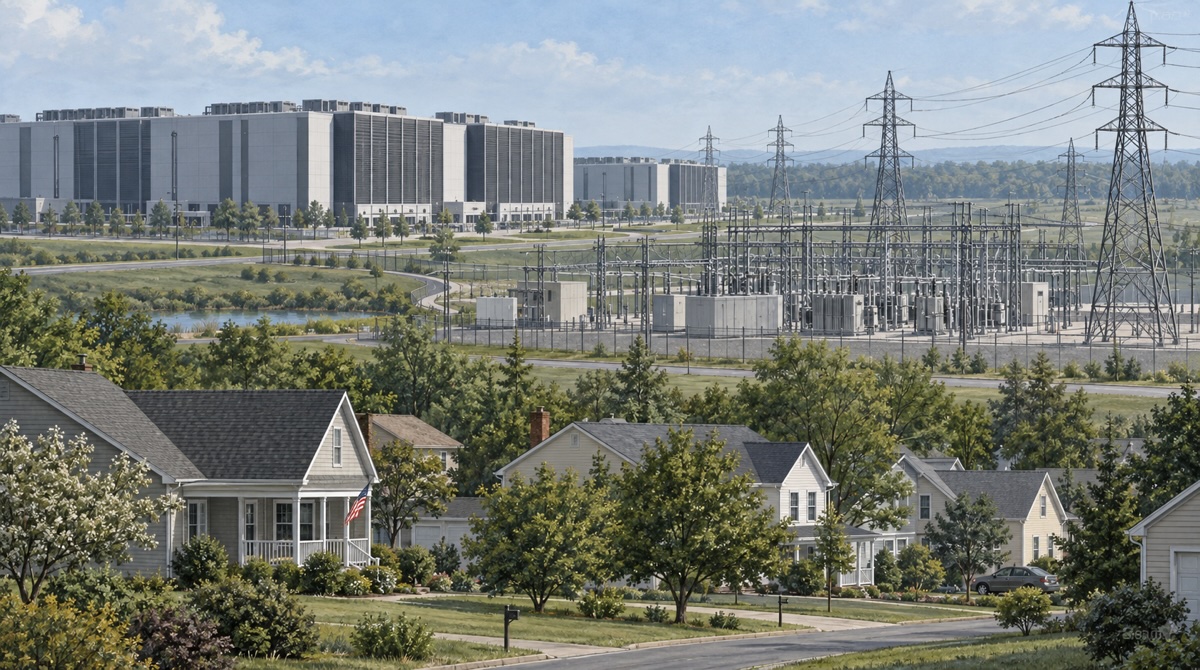
AI-generated image: synthetic visual, not an actual depiction of events, people, or locations.
CenterPoint Energy said a surge in electricity demand from data centers and other large users could save existing Texas customers more than $5 billion over the next decade by spreading grid costs across a broader customer base.
The forecast depends on as much as 14 gigawatts of proposed large-load projects connecting to CenterPoint’s Houston-area network. It does not represent an immediate bill credit or a guaranteed pool of savings. The projects must advance through grid studies, regulatory approvals and construction before their expected demand can contribute to the utility’s revenue.
CenterPoint is a Houston-based regulated energy-delivery company whose operations include electric transmission and distribution, natural-gas distribution and power generation. The New York Stock Exchange-listed company serves more than 7 million metered customers in Texas, Indiana, Minnesota and Ohio and had about $48.3 billion of assets as of June 30.
In Greater Houston, CenterPoint’s role is narrower than that of a conventional integrated power company. Its Houston Electric subsidiary owns and maintains the poles, wires, substations and other infrastructure that carries electricity to almost 2.9 million customers. It does not generate the electricity or sell retail power plans. Consumers buy their electricity from competing retail providers, while CenterPoint collects regulated delivery charges through those providers for operating and investing in the network, according to the company’s 2025 annual filing.

That distinction is central to CenterPoint’s savings projection. The company said in a Tuesday press release that large new users would pay a share of fixed transmission and distribution costs that otherwise would be recovered from existing residential and commercial customers. The claimed savings therefore relate primarily to the delivery portion of customers’ bills, not to the competitively priced electricity supplied by retail providers.
The potential 14 gigawatts comprise projects CenterPoint expects to qualify as “base load” or “studied load” under an Electric Reliability Council of Texas review. That amount would increase demand on its Houston electric system by more than 65% from the current peak of about 21 gigawatts, according to the company.
CenterPoint did not provide annual savings estimates, a per-customer figure or detailed calculations supporting the $5 billion projection. The total is forward-looking and depends on how many proposed projects are ultimately built, when they begin operating, how much power they use and how regulators allocate infrastructure costs.
The company first disclosed the savings estimate with its second-quarter results on July 28. At the time, it said it had submitted more than 17 gigawatts of proposed projects to ERCOT’s initial large-load review, with approximately 14 gigawatts expected to qualify for further consideration and potentially enter service by 2031.
CenterPoint also raised its 2026-2035 capital plan by $1.2 billion to $66.7 billion, partly to accommodate faster demand growth in Houston. Connecting large users can expand the utility’s investment opportunities and regulated asset base while potentially easing the amount existing customers must pay for each unit of electricity delivered.
The initiative illustrates both the financial opportunity and the regulatory challenge created by data-center development. Large connections can generate additional revenue and support grid investment, but they also require transmission lines, substations and generation capacity. Other customers could be left paying for underused infrastructure if projects are canceled or consume substantially less power than developers forecast.
Texas sought to address that risk through Senate Bill 6, enacted in 2025. The law directs regulators to establish uniform standards for large-load interconnections, require qualifying customers to contribute to connection costs and improve the credibility of demand forecasts. It generally applies to projects of at least 75 megawatts and also permits large loads to be curtailed during grid emergencies.
A Texas Senate analysis said the legislation was designed to allocate transmission expenses more accurately, protect reliability and reduce the risk that residential customers subsidize speculative projects. CenterPoint said the projects included in its savings estimate are subject to those protections.
The announcement also follows calls from Texas Governor Greg Abbott for data-center developers to disclose more information and meet standards covering grid reliability, natural resources and community effects. Abbott said in July that a proposed East Texas data center had been withdrawn after failing to meet those expectations. The governor’s office said developments that do not satisfy the standards should not proceed.
CenterPoint has also endorsed the federal Ratepayer Protection Pledge, an initiative intended to prevent the power-infrastructure costs associated with data centers from being shifted to households and other existing users. The US Energy Department has promoted the pledge as part of its policy for expanding electricity supply alongside artificial-intelligence infrastructure.
CenterPoint said the infrastructure component of its Houston customers’ bills increased by slightly more than 1% annually from 2014 through 2025. It also asserted that its per-kilowatt-hour delivery charges are the lowest among Texas’ investor-owned transmission and distribution utilities. Those comparisons were supplied by the company and were not accompanied by supporting calculations in Tuesday’s release.