The disclosure comes during a sharp selloff in publicly traded AI infrastructure companies, with IREN shares falling by double digits Thursday as investors reacted to reports that Microsoft was increasing scrutiny of development delays at several neocloud partners.
IREN also reported a quarterly net loss of $263 million, compared with a $684 million loss in the preceding quarter, while adjusted EBITDA increased to $66 million from $19 million.
AI Cloud Revenue Nearly Triples as Mining Declines
IREN's latest results underscore how quickly its revenue mix is shifting away from bitcoin mining.
Of the $200 million in AI Cloud revenue, approximately $135 million came from GPU cloud services, while $65 million was attributable to AI Cloud leasing.
Bitcoin mining revenue fell to $28 million from $67 million in the previous quarter, reflecting the company's ongoing retirement of mining equipment and conversion of infrastructure to AI computing.
The shift is significant compared with IREN's previous fiscal year, when bitcoin mining still accounted for most of its $707 million in annual revenue.
As TheEnergyMag reported following IREN's fiscal 2026 earnings, the company has been repurposing its existing power and data center infrastructure while building a vertically integrated business encompassing facilities, GPU systems and software.
IREN reported an AI Cloud segment gross margin of approximately 86%, consistent with the previous quarter. That measure excludes depreciation and certain site-level costs, meaning it should not be interpreted as a consolidated GAAP profit margin.
Despite the improvement in revenue and adjusted EBITDA, IREN recorded a $263 million net loss during the September quarter.
The results included $148 million in depreciation and amortization, $106 million in stock-based compensation and $73 million in finance expenses.
The widening scale of these expenses illustrates the capital-intensive nature of the company's transition, even as revenue from its GPU fleet continues to increase.
$4 Billion ARR Deployment Target Moves Into 2027
IREN said its target of more than $4 billion in contracted annualized revenue remains fully contracted and funded, but the corresponding capacity is now expected to become operational in January 2027, potentially extending into February.
The company previously targeted completion by the end of December 2026.
According to management, a customer-requested design change and supplier timing contributed to the revised schedule.
The distinction between contracted ARR and recognized revenue is critical.
IREN's ARR target estimates the annualized revenue potential of contracted GPU capacity once operational, based on contracted pricing and expected utilization. It does not represent revenue already earned.
Revenue recognition remains dependent on commissioning, testing, customer acceptance and service delivery.
In August, the company reported approximately $1 billion of operating ARR while targeting more than $4 billion once its contracted 2026 capacity was deployed.
The latest disclosure indicates that the company is still working toward bringing the remaining contracted infrastructure into service.
The delay comes amid broader scrutiny of neocloud development schedules.
Reuters reported Thursday, citing Bloomberg News, that Microsoft was tightening oversight of projects involving IREN, Nebius (NASDAQ: NBIS) and Nscale. The report triggered a sharp decline in shares of AI infrastructure providers.
Separately, The Information reported that delays involving third-party providers, including IREN, contributed to Microsoft's lower-than-expected capital spending during its September quarter.
These external reports have not established that every delay identified by Microsoft corresponds directly to the schedule adjustment disclosed in IREN's earnings release.
Nevertheless, the disclosures highlight a common risk facing AI infrastructure developers: contracts and hardware orders do not necessarily translate into revenue on their originally expected schedules.
Revenue Backlog Reaches $20.3 Billion
IREN reported approximately $20.3 billion in revenue backlog at September 30, a 22% increase from the previous quarter.
The company said roughly two-thirds of the backlog is supported by investment-grade counterparties or guarantors.
The backlog reflects expected revenue from committed customer contracts, including cloud services and leasing arrangements, subject to delivery and availability requirements.
IREN's customer portfolio includes Microsoft, NVIDIA and a growing range of enterprise AI developers and frontier laboratories.
Following the September quarter, the company said it expanded an existing contract with a leading frontier AI laboratory.
It also disclosed two additional commercial arrangements that indicate potentially improving pricing for AI compute capacity.
One five-year agreement carries estimated annual revenue of approximately $22 million per megawatt of critical IT load, with customer prepayments covering approximately 90% of the associated GPU capital expenditure.
Another short-term contract carries estimated annual revenue of $40 million per IT megawatt.
The company did not disclose the total capacity covered by those arrangements, making it difficult to determine their contribution to future revenue from the disclosed pricing alone.
The economics of the five-year agreement are particularly relevant given the industry's substantial hardware financing requirements.
Large upfront customer payments can reduce the amount of capital a GPU cloud provider needs to borrow or raise from equity investors before its infrastructure begins generating revenue.
However, such contract structures are customer-specific and may not be available across future deployments.
$15 Billion Spending Plan Highlights Financing Requirements
IREN's rapidly expanding business comes with considerable capital requirements.
The company reported approximately $20.6 billion in total assets at September 30, including roughly $12.3 billion in property, plant and equipment.
Its balance sheet included $3.52 billion in unrestricted cash and cash equivalents, alongside approximately $2.26 billion in restricted cash.
Total debt, including finance lease liabilities, reached approximately $10.2 billion, compared with $7.8 billion at June 30.
IREN reported net debt of approximately $4.43 billion, up from $216 million three months earlier.
The increase reflects the company's rapid deployment of capital as it develops data centers and finances GPU equipment.
Cash used in investing activities totaled approximately $5.15 billion during the September quarter, including substantial spending on computing hardware and infrastructure.
Looking ahead, IREN outlined approximately $15 billion in remaining planned fiscal 2027 capital expenditures, measured from September 30.
Of that amount, approximately $9 billion is expected to be supported by existing cash, committed GPU financing and contracted customer prepayments.
The remaining $6 billion depends on targeted GPU financing, additional prepayments, data center financing and other corporate funding sources that remain subject to market conditions.
IREN said the more than $4 billion ARR program is funded through identified cash, committed financing and customer prepayments, subject to applicable financing conditions.
That funding status should not be confused with full financing of the company's broader expansion plans.
As financial markets increasingly question the economics of AI infrastructure investment, access to affordable capital and the timing of customer payments remain important determinants of how quickly IREN can expand.
Sweetwater Gains ERCOT Recognition as Development Pipeline Expands
Beyond its existing GPU deployments, IREN continues to advance its power and data center development portfolio.
The company reported more than 5 gigawatts of secured power capacity across its facilities, supported by more than 30,000 acres of owned or optioned land.
It also identified a development pipeline exceeding 35 GW of potential gross power capacity.
However, the company cautioned that the larger development pipeline is speculative, includes projects without executed grid connection agreements and is not expected to result in a significant proportion of that capacity becoming secured.
In Texas, IREN said its 2 GW Sweetwater hub has received conditional inclusion in ERCOT's Batch Zero process under its base-load classification.
As TheEnergyMag previously examined, the process has become increasingly important for large computing developments seeking access to constrained electricity infrastructure.
The conditional designation is not equivalent to final authorization to consume all 2 GW of power. Development remains subject to additional regulatory, utility and construction requirements.
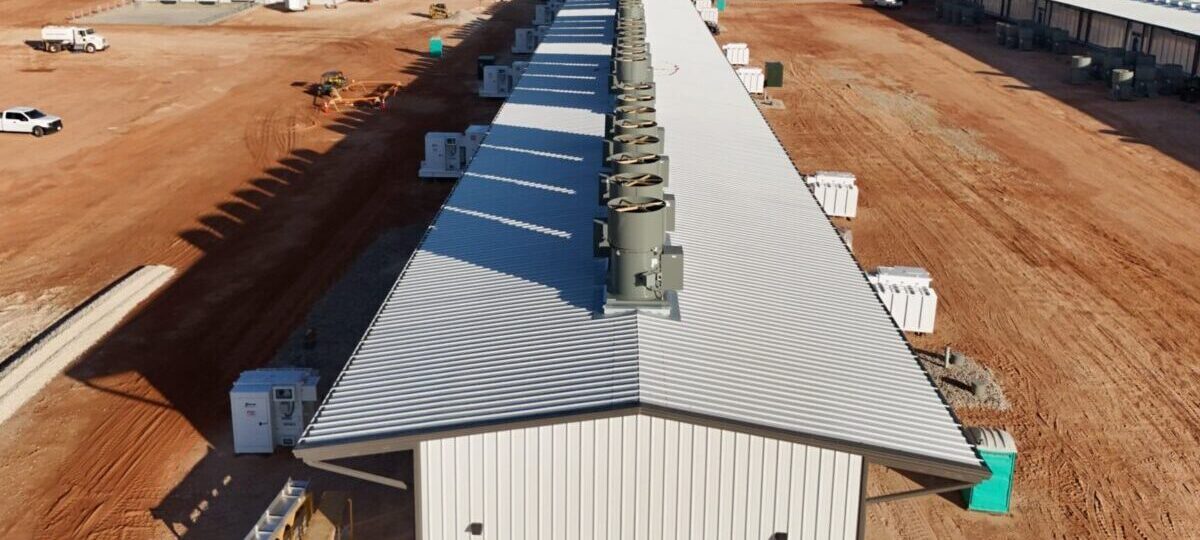
IREN also reported construction and commissioning progress across its Horizon deployments at Childress, Texas, where the first 50 MW liquid-cooled facility has been delivered to Microsoft.
The company said the Horizon 1 deployment achieved NVIDIA Exemplar Cloud status for GB300 NVL72 systems, while additional phases continued through construction and commissioning.
Other developments include new liquid-cooled data center construction at its 100 MW Mackenzie site and an early-stage 300 MW project in Badajoz, Spain, where civil works licensing has been secured.
Execution Concerns Meet a Broad AI Selloff
IREN's earnings arrive at a difficult moment for AI infrastructure equities.
Shares of IREN, Nebius and other neocloud providers fell sharply Thursday following reports of tighter Microsoft oversight, compounding a broader technology selloff driven by concerns over capital spending, project financing and regulatory uncertainty.
The Nasdaq Composite also entered correction territory as investors increasingly questioned whether planned AI infrastructure investments could be developed and monetized quickly enough to justify their costs.
For IREN, the latest results present contrasting signals.
The company is generating substantially more revenue from AI Cloud services, expanding its contracted backlog and securing customer commitments that can help finance future GPU deployments.
At the same time, its flagship annualized revenue milestone has slipped, net debt has increased substantially and a significant portion of its broader development spending still requires additional financing.
Those developments illustrate the increasingly important distinction between demand for AI computing capacity and the ability to deliver that capacity on time and at sustainable economics.
IREN's next milestones will include completing its delayed deployments, converting contracted ARR into recognized revenue and securing funding for additional capacity beyond the current program.
For investors, those execution and financing measures may ultimately prove more consequential than the pace of new contract announcements alone.